Guides
How to Summarize YouTube Videos with AI (Right on the Watch Page)
The fastest way to summarize YouTube videos with AI is an extension that puts the summary on the watch page itself. Here's how — plus honest alternatives.
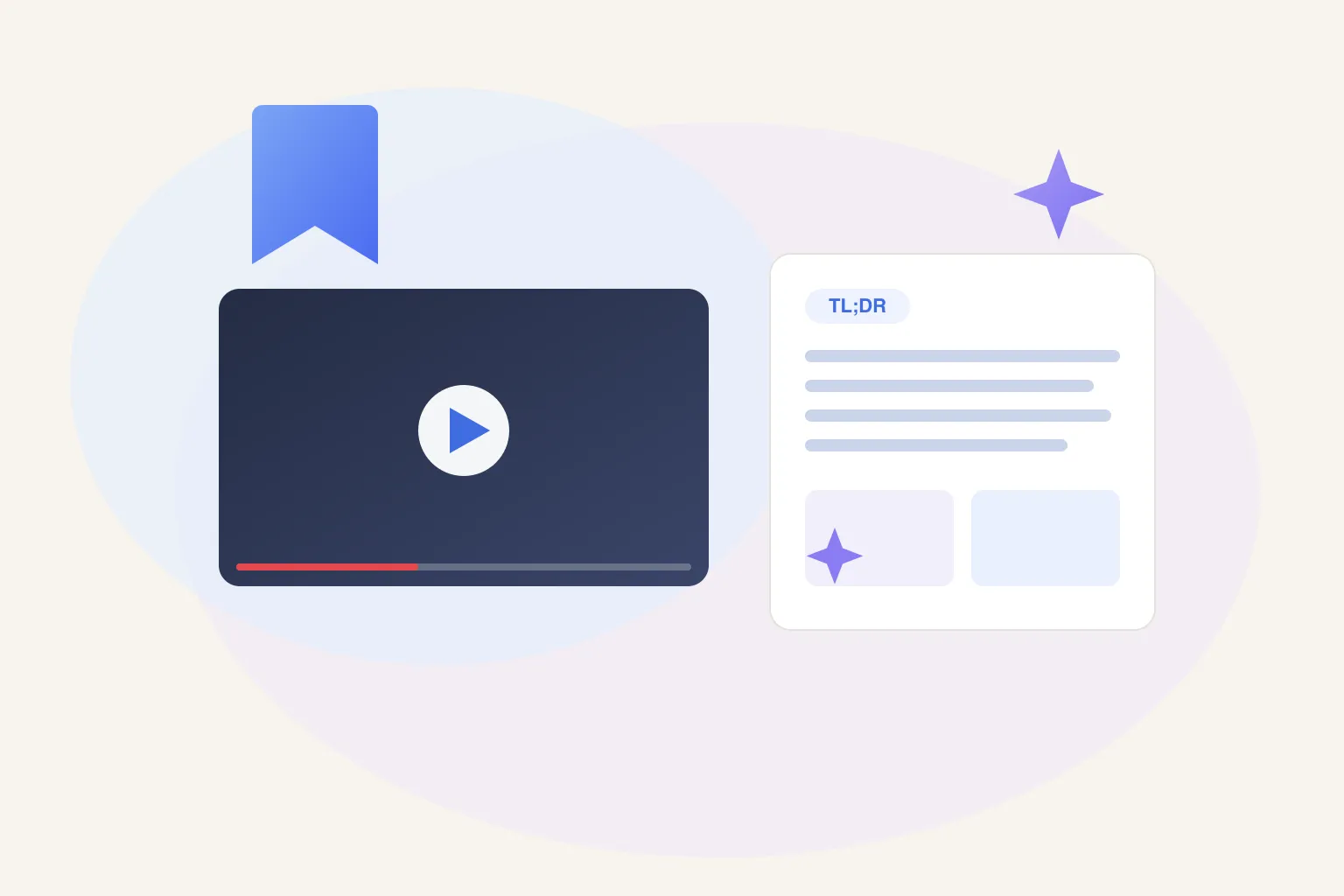
To summarize a YouTube video with AI, you have three options: copy the transcript into ChatGPT, paste the URL into a summarizer website, or install a browser extension that generates the summary on the watch page itself. The extension route is fastest — the summary appears next to the video within seconds, with no copying and no tab-switching.
The rest of this guide walks through all three methods honestly, including exactly how many steps each one costs you per video, and ends with what a good AI summary should actually look like.
YouTube’s own captions & transcript help (checked October 6, 2026) is the reference for what the native transcript actually is — creator captions, community captions (retired), and auto-generated ones. Every summarization method here builds on that transcript, so when a video has none (mute uploads, live still running), no summarizer can invent one; that’s a data limit, not a tool failure.
Why summarize a YouTube video before watching it?
Because video hides its value behind a scrub bar. A 40-minute podcast might have eight minutes you care about. A 25-minute tutorial might bury the actual fix at 19:40. The thumbnail and title are marketing; they tell you what the creator wants you to click, not what the video delivers.
Text doesn’t have this problem. You can skim an article’s intro and headers in fifteen seconds and know whether to commit — it’s why read-it-later apps work so well for written content. Video gives you nothing to skim. Chapters help when creators bother to add them; most don’t.
An AI summary restores the triage step. Thirty seconds of reading tells you whether to watch the whole thing, jump to one section, or close the tab. Multiply that across a watch-later backlog and it’s hours back per week — you stop paying 40 minutes to find out a video wasn’t worth 40 minutes.
How do you summarize a YouTube video with ChatGPT?
You feed it the transcript. ChatGPT can’t reliably watch a video from a URL, but it’s genuinely good at summarizing a transcript you paste in. Here’s the honest procedure:
- Open the video on YouTube, expand the description, and click Show transcript.
- Select and copy the transcript text. (There’s no copy-all button, so you’re scroll-selecting — here’s the full walkthrough on getting a YouTube video transcript.)
- Open ChatGPT in another tab.
- Paste the transcript with a prompt like “Summarize this video transcript as a TL;DR plus key points.”
- Wait for the response.
- Copy anything you want to keep somewhere else, because the chat thread has no connection to the video.
It works, and the quality is solid. But count the friction: six manual steps, two tabs, and a couple of minutes per video. Very long videos can exceed what you can comfortably paste in one go, which means splitting the transcript into chunks and stitching summaries together. And the output lives in a chat history you’ll never find again, completely disconnected from the video it describes.
For one video a week, fine. For the fifth video today, you’ll stop bothering — which means you’re back to gambling 40 minutes on a thumbnail.
What about YouTube summarizer websites?
These are the paste-a-URL tools: copy the video link, open the summarizer site, paste, wait, read. Fewer steps than the ChatGPT method — call it three or four per video — and no transcript wrangling, since the site fetches it for you.
The honest trade-offs:
- You still leave the video. The summary lives on someone else’s website, in another tab, away from the player. If the summary convinces you to watch, you’re now juggling two tabs to follow along.
- Free tiers are ad-heavy and rationed. Most of these sites monetize with ads around the summary, daily limits, or both. Usable, not pleasant.
- Nothing is saved anywhere useful. Close the tab and the summary is gone. There’s no library, no search, no connection to your other saved videos.
- Follow-up is rare. Most summarizer sites give you a static block of text. If the summary raises a question, you can’t ask it.
Summarizer sites are a reasonable middle ground for occasional use. The friction is lower than copy-pasting into ChatGPT, but the summary is still somewhere the video isn’t.
How do you get an AI summary directly on the watch page?
Install an extension that renders the summary next to the video. The Marqly extension adds a persistent AI card at the top of YouTube’s sidebar — on the watch page itself, not a popup, not a new tab. It has three tabs: Summary, Chat, and Transcript. Here’s the whole workflow:
- Install the extension — it works on Chrome, Edge, Firefox, and Safari, and it’s free to install with free AI summaries included to start.
- Open any YouTube video. The card is already there, at the top of the sidebar next to the video.
- Watch the summary write itself. It streams in live within seconds — a TL;DR box up top, then structured sections with key points. If the video was summarized before, the cached summary appears instantly.
- Go deeper if the video earns it. The Chat tab lets you ask questions about the video with answers grounded in the transcript — starter question chips get you going, and you can interrogate a claim before deciding to watch. (Chat is a Pro feature; here’s a full guide to chatting with YouTube videos.) The Transcript tab shows the full transcript synced to playback — the current segment highlights as the video plays — with one-click copy.
- Save the good ones. Marqly adds a Bookmark button to YouTube’s own action row, next to Like and Share. Saving stores the video in your Marqly library with the transcript attached, so months later you can find it by describing what it was about — no title or channel name required.
One more detail worth calling out: if the creator mentions books, they appear under the summary with covers in a “Mentioned in this video” section — click one to look it up. Podcast and interview channels reference books constantly, and this saves the “wait, what was that book called” scrub-back.
The step count per video is effectively zero. You open a video the way you always do, and the summary is just there.
How do the three methods compare?
| ChatGPT copy-paste | Summarizer sites | On-page extension (Marqly) | |
|---|---|---|---|
| Steps per video | ~6 manual steps | 3–4 (copy URL, paste, wait) | 0 — open the video |
| Where the summary lives | A chat thread in another tab | Someone else’s website | On the watch page, next to the video |
| Chat follow-ups | ✅ in the chat thread | ❌ mostly static text | ✅ grounded in the transcript (Pro) |
| Transcript access | Manual copy from YouTube | ⚠️ varies by site | ✅ synced to playback, one-click copy |
| Saves to a library | ❌ | ❌ | ✅ with transcript attached, searchable by meaning |
The honest read of this table: ChatGPT gives you the most control over the prompt, summarizer sites are the lowest-effort option that needs no install, and the extension wins on everything that involves doing this more than occasionally. The structural difference is where the summary lives. The first two methods put it somewhere the video isn’t; the extension puts it where you already are.
What does a good AI video summary look like?
Not a wall of text. A summary you have to read carefully is a summary that failed — the whole point is deciding fast. A good AI summary of a YouTube video has a shape:
- A TL;DR box up top. Two or three sentences that answer “what does this video claim, and is it worth my time?” This is the triage layer — most of the time it’s all you’ll read.
- Structured sections underneath. Key points grouped under headers that mirror the video’s actual argument, so you can scan to the part you care about and know roughly where it lives in the timeline.
- A path to go deeper. The summary should be a door, not a wall: the full transcript one tab away, and ideally the ability to ask a follow-up question when a key point is intriguing but underexplained.
This shape is exactly what Marqly’s Summary tab renders — TL;DR box, then sections with key points, with Transcript and Chat one tab over. If a tool hands you six undifferentiated paragraphs instead, you’ve traded a 40-minute watch for a 5-minute read that still doesn’t tell you where anything is.
One more mark of a good system: the summary shouldn’t evaporate. If you triage a video, decide it’s worth keeping, and save it, the summary and transcript should come with it — that’s what turns a black-hole Watch Later list into a library you can actually search.
Put an AI summary on every watch page
The fastest way to summarize YouTube videos with AI is to stop moving the transcript to the AI and start putting the AI where the video is. The Marqly extension adds the summary card to every YouTube watch page — streaming summaries with a TL;DR and key points, a synced transcript, and one-click saving to a searchable library.
It’s free to install on Chrome, Edge, Firefox, and Safari, with free AI summaries to start. Marqly Pro unlocks chat with videos and heavier use — $72/year (about $6/month billed annually).
Open the next long video on your list and read the summary before you commit the 40 minutes.
Related: How to Save YouTube Videos to Watch Later · Chat with YouTube Videos
Frequently asked questions
- What is the fastest way to summarize a YouTube video with AI?
- Use a browser extension that puts the summary on the watch page itself. Marqly adds an AI card at the top of YouTube's sidebar: open a video and the summary streams in within seconds — a TL;DR box followed by structured key points. No copying transcripts, no pasting URLs into another site, no leaving the page.
- Can ChatGPT summarize a YouTube video?
- Yes, but you have to feed it the transcript yourself. ChatGPT can't reliably watch a video from a link, so the working method is: open the transcript on YouTube, copy it, paste it into ChatGPT with a prompt, and wait. It works, but it's about six manual steps per video, and the summary lives in a chat thread, not with the video.
- Is the Marqly YouTube AI summary free?
- Yes to start. The extension is free to install on Chrome, Edge, Firefox, and Safari, and includes free AI summaries so you can try it on real videos. Marqly Pro unlocks chat with videos and heavier use — it costs $72 per year, which works out to about $6 per month billed annually.
- Can I ask an AI follow-up questions about a YouTube video?
- Yes. The Marqly card has a Chat tab where you ask questions about the video and get answers grounded in the actual transcript, with starter question chips to get you going. Because answers come from what was actually said, you get citations of the content rather than guesses. Chat is a Marqly Pro feature; summaries are included free to start.
- What should a good AI summary of a YouTube video look like?
- A short TL;DR up top that tells you in two or three sentences whether the video is worth your time, followed by structured sections with key points you can scan. A wall of paragraphs defeats the purpose — you'd spend nearly as long reading it as watching at 2x. Skimmable structure is the whole point of summarizing.