Guides
How to Chat With a YouTube Video (Ask Questions, Get Real Answers)
Yes, you can chat with a YouTube video. Ask questions and get answers grounded in the transcript, right next to the player. Here's how to set it up free.
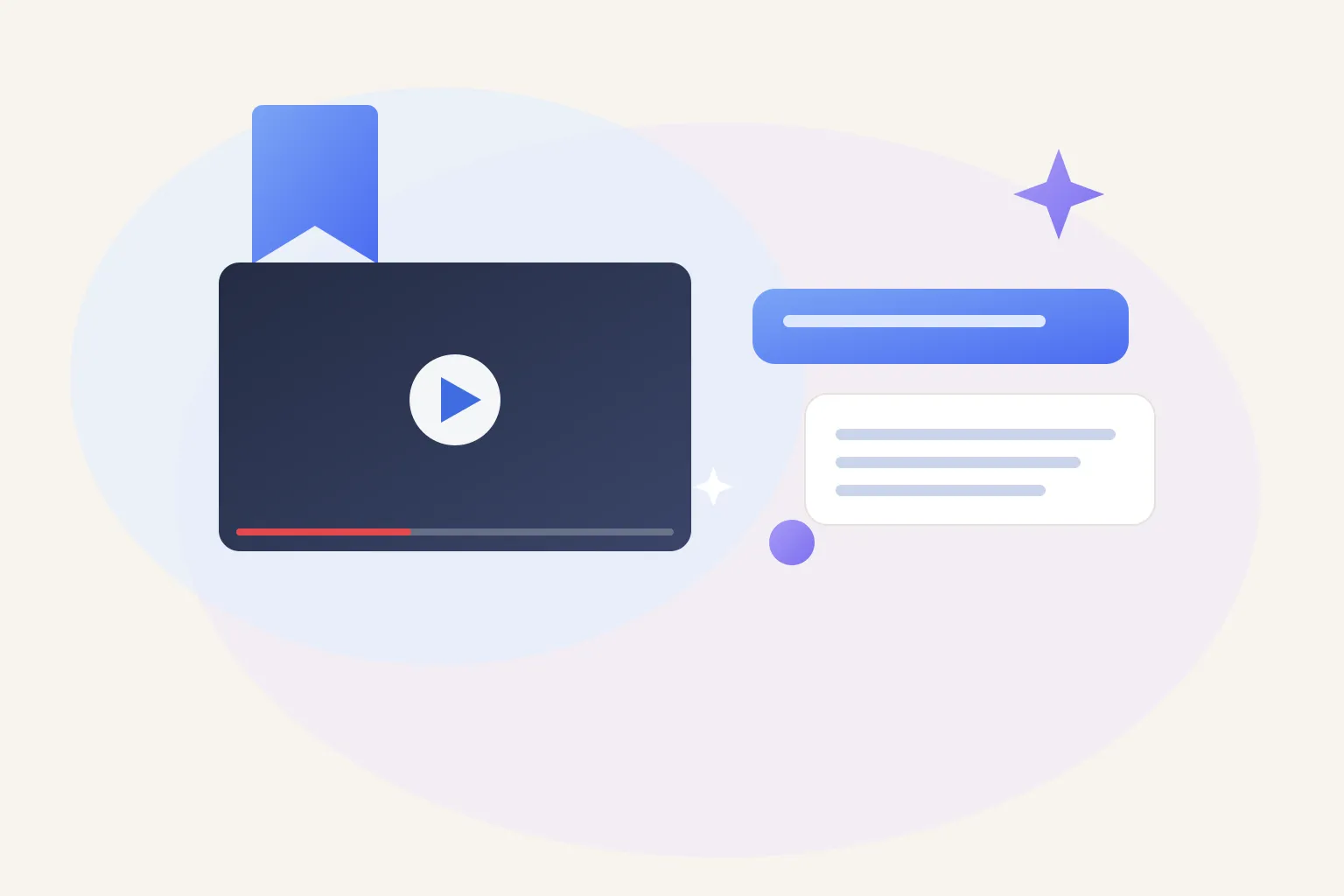
Yes — you can chat with a YouTube video. An AI tool reads the video’s transcript and answers your questions in plain language, grounded in what was actually said rather than guesses. The fastest way to set it up is a browser extension that puts the chat right next to the player, so you can ask without leaving the page.
That turns every video into something you can interrogate. Instead of scrubbing a 40-minute talk for the two minutes that answer your question, you type the question and get the answer. This guide covers why that beats the timeline, how to do it manually for free, what “grounded in the transcript” actually means, and how to get it in one click.
Why chat with a video instead of scrubbing the timeline?
Because video is linear and your question isn’t. A 40-minute talk stores its information sequentially — the one answer you need lives at minute 23, or minute 31, and the seek bar won’t tell you which. Scrubbing is guessing with a progress bar.
The usual workarounds all cost more than they should. Chapters only exist if the creator bothered to add them, and they’re labeled by the creator’s logic, not yours. Watching at 2x speed still burns 20 minutes to recover one fact. Scanning the comments for a timestamp only works if someone else already asked your exact question.
Chat inverts the format. You bring the question; the AI has already read the entire transcript, so it goes straight to the relevant part and tells you what was said there. It also works before you commit: ask “does this talk actually cover migrating from Postgres?” and you’ll know in ten seconds whether the video deserves 40 minutes of your day. That pre-check alone changes how you triage a subscriptions feed full of long-form content.
How do you chat with a YouTube video manually?
You can do this today with a chatbot you already use, and it’s worth knowing the manual route even if you never use it again — it makes clear what the automated version is saving you.
- Open the video’s transcript on YouTube: expand the description and click Show transcript. (Full walkthrough here: how to get a YouTube video’s transcript.)
- Toggle off timestamps so the text copies cleanly.
- Select the entire transcript and copy it — fiddly on long videos, where the panel holds thousands of lines.
- Open ChatGPT, Claude, or another chatbot in a new tab.
- Paste the transcript with an instruction like “Answer my questions using only this transcript.”
- Ask your question.
Honest verdict: it works, and it’s free. The chatbot will answer from the pasted text, and for a one-off question about a single video, this is a perfectly good move.
The problems show up on the second video, and the second day. It’s six steps per video, every video. You’ve left the watch page, so the answer and the player now live in different tabs. And the context is disposable: come back tomorrow with a follow-up question and the session is gone or buried, so you repeat all six steps to re-establish what the chatbot knew yesterday. Nothing is saved with the video, nothing accumulates. Do this three times in a week and the novelty wears off fast.
What does “grounded in the transcript” mean?
It means the AI’s answers are restricted to what the video actually says. A grounded chat reads the full transcript and answers from that text — citing what was actually said — instead of improvising from general knowledge.
That distinction is the difference between a real answer and a confident guess. Paste just a YouTube link into a general chatbot and it often can’t watch the video at all; it will happily “summarize” from the title and whatever it remembers about the topic, and get the specifics wrong. That failure is invisible, which is what makes it dangerous — the wrong answer reads exactly like the right one.
Grounding closes that gap in two ways. First, answers come from the words the speaker used, so you’re getting the video’s claims, not the internet’s average take on the subject. Second, absence is reported honestly: if the speaker never mentioned your topic, a grounded chat tells you it wasn’t covered rather than inventing something plausible. For anything you’d act on — a config step in a tutorial, a form cue in a training video, a claim in a news breakdown — that property is what makes the answer usable.
How do you chat with a YouTube video using Marqly?
Marqly’s extension collapses the six manual steps into a card that’s already on the page. Setup:
- Install the free extension — it works on Chrome, Edge, Firefox, and Safari.
- Open any YouTube video. A persistent AI card appears at the top of the sidebar, right next to the player, with three tabs: Summary, Chat, and Transcript.
- Open the Chat tab.
- Ask anything — or tap one of the starter question chips, which suggest good first questions when the chat is empty.
Answers are grounded in that video’s transcript, so they reflect what was actually said. The video keeps playing while you ask; nothing opens in another tab, and there’s nothing to copy or paste.
The other two tabs round out the workflow. The Summary tab streams a TL;DR plus structured sections in seconds — useful for triage before you even have a question (here’s how AI YouTube summaries work). The Transcript tab is synced to playback, so when an answer points you at a claim, you can jump into the transcript and hear it in context.
Pricing, plainly: Chat is a Marqly Pro feature — $72/year, which works out to about $6/month billed annually. Summaries have a free tier, so the card is useful before you pay anything.
What questions should you ask a YouTube video?
The best questions are the ones that would otherwise force a rewatch — precise asks with a precise answer sitting somewhere in the transcript. Prompts that consistently work well:
- “List the exact steps in this tutorial, in order, including any settings or values mentioned.”
- “Does this talk cover [your specific question]? If yes, what does the speaker say about it?”
- “Give me the full ingredient list, with quantities.”
- “What evidence does the speaker give for [claim]? Quote what they actually said.”
- “Which tools does the video use, and what is each one for?”
- “What does the speaker warn against or say to avoid?”
- “What’s the speaker’s final recommendation, and what caveats come with it?”
Notice the pattern: every one of these has a definite answer at some unknown timestamp. That’s exactly the retrieval problem a linear timeline is worst at and a grounded chat is best at. Vague prompts (“thoughts on this video?”) waste the tool; specific prompts make it feel like a superpower.
Copy-paste into ChatGPT vs. chat next to the player — which wins?
Both routes produce real, transcript-based answers. The difference is friction — per video, and compounding over time.
| Friction point | Copy-paste into ChatGPT | On-page chat (Marqly) |
|---|---|---|
| Steps per video | 6 | 1 — open the Chat tab |
| Stays next to the video | No — separate tab | Yes — card in the sidebar |
| Follow-up questions | Context gone next session; repeat the paste | Chat is right there every time you open the video |
| Saved with your library | No | Yes — bookmark the video with the transcript attached |
The fair read: if you question one video a month, the manual route is fine and costs nothing. If asking questions of videos becomes part of how you learn — tutorials, conference talks, reviews, lectures — the per-video tax is the whole story, and chat that lives on the watch page wins without a contest.
Can you save a video and keep asking later?
Yes, and this is where a one-off chat turns into something compounding. Marqly adds a Bookmark button to YouTube’s action row — right in the row with Like and Share. One click saves the video to your Marqly library with the transcript attached.
That matters in two ways. First, retrieval: weeks later you can find the video by describing it — “the talk about pricing for solo founders” — instead of hoping you remember the title or the channel. Second, your videos join the same library as your reading, and chat works alongside your saved articles too — so videos stop being second-class citizens in your knowledge base. Saved and askable beats watched and forgotten; that’s the working definition of an AI second brain.
And if your Watch Later list is where videos currently go to die, there’s a better way to save YouTube videos for later — one where the saved video is still answerable next month, not just sitting in a queue.
Stop scrubbing. Start asking.
“Can I chat with a YouTube video?” has a simple answer in 2026: yes — and the chat should live next to the player, not in another tab with a pasted transcript. Install the extension, open any video, and ask the question you’d otherwise scrub for.
Install the free extension — it works on Chrome, Edge, Firefox, and Safari. Summaries are free, so you can test the card on a real video before paying a cent — Chat unlocks when you upgrade to Pro.
Related: How to summarize YouTube videos with AI · How to get a YouTube video’s transcript
Frequently asked questions
- Can you chat with a YouTube video?
- Yes. AI tools can read a video's transcript and answer questions about it in plain language. The fastest setup is a browser extension like Marqly, which adds a chat panel next to the player on every watch page — you ask a question and get an answer grounded in what the video actually says, without scrubbing the timeline.
- How do I ask questions about a YouTube video without watching it?
- Open the video and ask your question in a chat tool that reads the transcript. With Marqly, the Chat tab sits next to the player: type something like 'does this talk cover pricing for solo founders?' and the answer comes from the transcript, so you can decide in seconds whether the video is worth your time.
- Are the answers accurate, or does the AI make things up?
- Answers are grounded in the video's transcript, which means the AI is restricted to what was actually said instead of guessing from general knowledge. If the video never mentions your topic, a grounded chat says so rather than inventing an answer. That's the key difference between transcript-grounded chat and pasting a video link into a general chatbot.
- Is chatting with YouTube videos free in Marqly?
- Chat is part of Marqly Pro, which costs $72 per year — about $6 per month billed annually. Video summaries have a free tier, so you can test the card on real videos before paying, and installing the extension is free on Chrome, Edge, Firefox, and Safari.
- Can I save a YouTube video and chat with it later?
- Yes. Marqly adds a Bookmark button to YouTube's action row that saves the video to your library with the transcript attached. You can find it later by describing what you remember, and because chat works alongside your saved articles, your library becomes something you can question instead of just store.