Guides
What Is a Second Brain App? (And How to Build One From Your Bookmarks)
A second brain app captures what you read and makes it searchable forever. Here's what they are, how they work, and how to build one from your bookmarks.
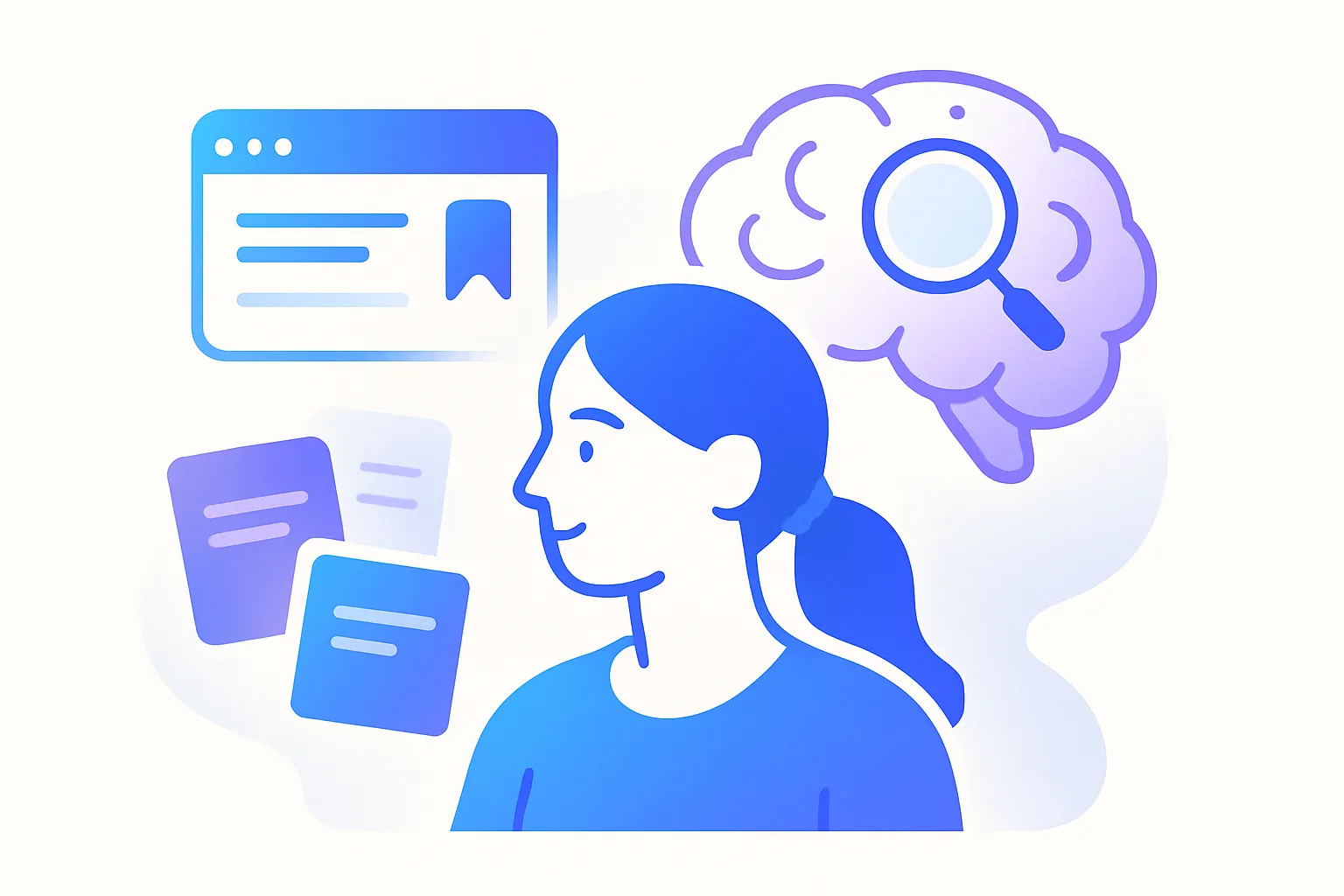
You read constantly — articles, threads, docs, research. But how much of it can you actually recall when you need it? For most people, the answer is “almost none.” The ideas wash over you and disappear. A second brain app is the fix: a place that captures what you read and makes it findable forever, so your past reading becomes a resource instead of a blur.
Here’s what a second brain actually is, how it differs from plain note-taking, and how to actually build one — starting from the bookmarks you’re already saving. The headline you should take from this guide: you almost certainly don’t need to build a wiki. The easiest second brain is the web you already save, made searchable by AI.
What is a second brain app?
A second brain app is software that stores your knowledge — notes, articles, ideas, and references — outside your head, so you can offload memory to a trusted system and retrieve any piece on demand. The good ones do three jobs: capture things quickly from anywhere, organize what you save automatically, and surface the right thing exactly when you need it.
The term itself comes from a concept called a “personal knowledge management” system, but the idea is much older than any app: write things down so you don’t have to remember them, then trust that you can find them again. The “second brain” framing just makes the goal explicit. Your first brain is for having ideas. Your second brain is for holding them — the citations, the half-formed thoughts, the article you read six months ago that suddenly matters today.
A second brain app turns that into software. The three jobs break down like this:
- Capture — save things quickly, from anywhere (web, phone, highlights). If capture takes more than one click, you’ll stop doing it.
- Organize — structure or tag what you save so it’s not chaos. The best tools do this for you instead of making you file.
- Retrieve — and this is the hard one — surface the right thing exactly when you need it, even when you’ve forgotten the title, the author, and where you saw it.
Most tools nail capture. A few do organize. Almost none, historically, did retrieve well — and retrieve is the only job that actually pays you back.
Where did the “second brain” idea come from?
The modern “second brain” idea was popularized by Tiago Forte’s book Building a Second Brain and its four-step CODE loop: Capture what resonates, Organize it for action, Distill it down to the essence, and Express it in your own work. It’s a genuinely useful framework — but for most people, the “organize” and “distill” steps are exactly where the system dies.
Forte’s method was written for serious knowledge workers willing to maintain a system: organizing notes into projects and areas (the PARA method), progressively summarizing highlights, and resurfacing them while writing. That works beautifully if knowledge work is your job and you enjoy tending a digital garden. It works much less well for a normal person who reads a lot, has good intentions, and does not want a second job maintaining a wiki.
So let’s reframe it for that normal person. You still want the loop — capture, organize, retrieve. You just don’t want to be the one doing the organizing and the distilling by hand. That’s the shift that makes a second brain stick: let software do the maintenance, and keep your effort at “save the thing, find the thing later.”
What’s the difference between a second brain, note-taking, and bookmarks?
A note-taking app is where you write knowledge; a bookmark manager is where you save it; a second brain does both — it captures effortlessly like a bookmark and retrieves intelligently like a well-organized notebook, without the manual writing. The distinction matters because it determines how much work the system demands of you, and therefore whether you’ll still be using it next month.
These three overlap, but they pull in different directions:
- Note-taking apps (Notion, Obsidian) start from a blank page. They’re powerful and flexible, but they require you to write. Most of what you read never becomes a note, because writing it up is friction — and friction at the moment of capture is fatal. You end up with a beautifully structured app containing 3% of what you actually consumed.
- Bookmark managers capture links effortlessly, but historically they’re write-only graveyards. You save and never return, because keyword search and nested folders don’t scale past a few hundred items. The save was easy; the finding was impossible.
- A true second brain captures as effortlessly as bookmarking and retrieves as intelligently as a well-organized notebook — without the manual writing. It takes the cheap-capture half of bookmarking and the smart-recall half of note-taking and fuses them.
The 2026 breakthrough is AI closing that gap. You save with one click (bookmark-easy), and AI does the organizing and makes everything semantically searchable (notebook-smart). That’s the AI version of a second brain — the same capture-and-recall idea, with the filing and finding handled for you. It’s why the practical answer to “which second brain should I build” has quietly changed: for most people, it’s no longer “set up Notion,” it’s “make the web you already save searchable.”
Do you need a heavy PKM tool like Notion or Obsidian?
No — a heavy PKM tool is one valid kind of second brain, but it’s not the easiest one. Notion and Obsidian reward people who want to write, link, and structure their own knowledge by hand. For everyone else, the lowest-effort second brain is the web they already save: bookmarks plus AI retrieval, with no schema to design and no wiki to maintain.
Think of it as two genuinely different products solving the same problem from opposite ends:
- Heavy PKM (Notion, Obsidian) is a note-taking-first system. You build the knowledge yourself — typing notes, linking pages, designing databases or a graph of backlinks. The payoff is total control and deep synthesis. The cost is that you are the organizing engine, forever.
- Lightweight, save-the-web (an AI bookmark manager) is a capture-first system. You save what you read and let AI tag and index it. The payoff is near-zero maintenance and instant recall. The cost is that it’s built around saved material, not long-form original writing.
Neither is “better” in the abstract — they’re tuned for different people. But most people who say they want a second brain don’t actually want to maintain a knowledge base. They want to stop losing things they’ve read. For that goal, the lightweight path wins almost every time. If you’re weighing the two directly, Obsidian vs. an AI bookmark manager lays out the trade-off in detail.
Here’s the contrast at a glance:
| Heavy PKM (Notion / Obsidian) | Lightweight (AI bookmark manager) | |
|---|---|---|
| Setup effort | High — design databases, folders, or a note structure before it’s useful | Low — install an extension, import existing bookmarks, done |
| Ongoing maintenance | High — you tag, link, and tidy by hand; rots if neglected | Near-zero — AI tags on save; nothing to maintain |
| Capture | Manual — you write or clip, then organize | One click — save the page, AI handles the rest |
| Best for | Writers, researchers, and synthesizers who want to build knowledge by hand | Readers who save a lot and just want to find it again |
| Retrieval | Keyword search and your own folder/link structure | Semantic search — ask by meaning, even if you forgot the title |
| Learning curve | Steep — a system to learn and tend | Flat — it works like saving a bookmark |
If you already love Obsidian and enjoy the craft of it, keep it — it’s a superb tool for the people it suits. But if you’ve bounced off three note apps because the upkeep beat you, that’s not a discipline problem. It’s a tool-fit problem, and the fix is a lighter tool.
Why do most second brains fail?
Most second brains fail because the upkeep exceeds the payoff. Elaborate folder hierarchies, tagging taxonomies, and PARA structures all demand constant manual maintenance, and the moment you get busy and skip a week, the system rots. The ones that survive have near-zero maintenance: you save, it organizes itself, and retrieval just works.
This is the single most important thing to understand before you build one, because it predicts success better than which app you pick. A second brain is only valuable if you keep using it, and you’ll only keep using it if it costs you almost nothing to maintain. Every manual step you add — every folder you have to choose, every tag you have to write, every weekly review you have to honor — is a place where real life eventually wins and the system dies.
So the design principle is brutal and simple: minimize the work between “I read something” and “it’s saved and findable.” The less filing you have to do, the more likely the habit survives a busy week, a sick kid, a deadline crunch. The systems that stick are the ones where the only ongoing actions are save and search — and a tool that auto-organizes is what makes that possible. This is also why organizing bookmarks by hand never works long-term: manual organization is exactly the maintenance tax that kills the system.
How do you build a second brain from your bookmarks?
To build a second brain from your bookmarks, pick a tool with AI capture and retrieval, import everything you’ve already saved for an instant backfill, then save new reading with one click and let the AI tag it. Retrieve by describing what you remember instead of digging through folders. You skip the wiki entirely and turn your existing saves into a searchable brain.
You don’t need to start from scratch or migrate to a complex note system. The fastest second brain is built from the reading you already do, in four steps:
- Pick a tool that captures and retrieves with AI. You want one-click saving, automatic tagging, and semantic search — so you can ask for things by meaning, not exact title. This combination is what separates a real second brain from a folder of dead links; the best AI bookmark managers in 2026 are built around exactly these three capabilities. The same tooling that lets you organize the bookmarks behind it is what turns a pile of saves into a brain.
- Import what you already have. If you’ve used Pocket, Raindrop, or browser bookmarks, import the lot — it’s an instant backfill of your “brain.” Years of saved reading become searchable on day one, instead of starting from an empty database that takes months to feel useful.
- Save as you read, with one click. Don’t sort. Don’t pick a folder. Don’t write a note. Just save and let the AI tag it. The whole point is to make capture so cheap that you do it reflexively, the way you’d glance at a headline.
- Retrieve by asking. When you need that half-remembered article — “the one about sleep and decision-making” — describe it. Semantic search finds it by meaning, even if your wording doesn’t match a single word in the original. No folder spelunking, no trying to reconstruct what you titled it.
That’s it. No taxonomy to design, no daily review ritual to maintain. The system does the organizing; you just keep reading and saving. The longer you run it, the more valuable it gets, because every save deepens a library you can now actually query.
What should you look for in a second brain app?
Look for frictionless one-click capture, automatic AI organization instead of manual folders, and semantic search that finds things by meaning. Those three are non-negotiable. Beyond them, AI summaries help you triage a backlog, and cross-device coverage ensures the tool works everywhere you actually read — web, phone, and desktop. If you’d rather skip straight to a shortlist, our roundup of the best second brain apps ranks the contenders against exactly these criteria.
Run any candidate through this checklist before you commit:
- Frictionless capture — a browser extension and a mobile share sheet. If saving is hard, you simply won’t do it, and a second brain you don’t feed is worthless.
- Automatic organization — AI tagging, not manual folders. The whole thesis of a low-maintenance second brain is that the tool files for you.
- Semantic search — find by meaning, not exact keywords. This is the feature that makes a brain a brain; it’s the difference between “I know I saved something about this” and actually pulling it up.
- Summaries — quick TL;DRs so you can triage a backlog without re-reading everything.
- It works where you read — web, phone, and desktop, in sync. Your reading is scattered across devices; your second brain can’t live on just one.
- Easy migration in — first-class import from Pocket, Raindrop, and browser exports, so adopting it doesn’t mean abandoning years of saved links.
A tool that hits all six gets out of your way. One that misses on capture or retrieval will quietly become another graveyard, no matter how nice it looks.
Build yours in two minutes
If “a second brain without the maintenance” is what you want, Marqly is built for exactly this path. It does the lightweight, save-the-web version of a second brain end to end: import your existing bookmarks from Pocket, Raindrop, or a browser export, save new things with one click from the web, iOS, or Chrome, and then ask your library for anything you’ve read — by meaning, not keywords. AI tags and summarizes each save automatically, so it does the organizing and you never touch a folder.
There’s a free tier to start with no credit card, and Pro is $72/yr (about $6/mo billed annually) or $9/mo when you want the full library. Turn the reading you’re already doing into a brain you can actually search.
Related: The Best AI Bookmark Manager in 2026 · 8 Best Pocket Alternatives
Frequently asked questions
- What is a second brain app?
- A second brain app is software that stores your knowledge — notes, articles, ideas, references — so you don't have to hold it all in your head. The good ones do three jobs: capture things quickly from anywhere, organize or tag what you save, and retrieve the right thing exactly when you need it.
- What's the difference between a second brain and a note-taking app?
- Note-taking apps like Notion or Obsidian start from a blank page and require you to write, so most reading never becomes a note. A true second brain captures as effortlessly as bookmarking and retrieves as intelligently as a well-organized notebook — without the manual writing.
- Why do most second brain systems fail?
- People abandon second-brain systems because the upkeep exceeds the payoff. Elaborate folder hierarchies, tagging taxonomies, and PARA structures demand constant maintenance, and miss a week and it rots. The systems that stick have near-zero maintenance: you save, it organizes itself, and retrieval just works.
- How do I build a second brain from my bookmarks?
- Pick a tool that captures and retrieves with AI, then import what you already have from Pocket, Raindrop, or browser bookmarks for an instant backfill. Save as you read with one click and let the AI tag it, then retrieve by describing what you remember instead of folder spelunking.
- Do I need Notion or Obsidian to have a second brain?
- No. Notion and Obsidian are powerful, but they're heavy note-taking tools that need you to write and maintain structure. For most people, the easiest second brain is the web they already save — bookmarks plus AI retrieval. You capture links effortlessly and let semantic search do the recall, with no wiki to tend.
- Is a second brain app worth it?
- It's worth it if you read a lot and forget most of what you read. A second brain pays for itself the first time you instantly find a half-remembered article you'd otherwise have lost. The trick is picking a low-maintenance tool — one that organizes itself — so the system survives past the first busy week.